
This post may contain affiliate links. Please read our disclosure policy.
Here’s how to make chicken stock at home on the stovetop, in a slow cooker, or in an instant pot so it comes out clean, rich, and delicious!

A pot of homemade chicken stock (or homemade broth) is one of the most satisfying practices. Good stock turns simple soup recipes, grains, and sauces into something restaurant-worthy. Once you start saving leftover chicken bones and making your own stock, store-bought stock from grocery stores will feel unnecessary!

Why I Love Homemade Stock
Learning how to make chicken stock at home is one of the first things I learned in culinary school. We moved immediately from our lesson in chopping on day one to the foundation for all French cooking, the “fond de cuisine”: stocks. Because I had not made stocks before, and was discovering how indispensable they are to all manner of good cooking, I found them fascinating.
What is most surprising about stocks is that, when homemade, they contain no salt. They are made to be used as an ingredient in preparations like soups, sauces, and braises and it’s not until then that seasonings like salt come into play. Learning to ‘get’ the flavor of stock without salt was a great lesson in probing the bare essentials and understanding how the true nature of basic flavors (like chicken, carrots, onion, celery) play out when salt is not involved.
I thought often of my Aunt Hilda when I was in school, and how she would greet me with a kiss and say, “you’re so delicious I could eat you without salt!” Not only did she, a fabulous Lebanese cook, understand the foundation of cuisine, but even more so the foundation of love. Not to mention charm.
Happy Cooking!
– Maureen

Why Make Homemade Chicken Stock?
Homemade stock pays you back in several ways:
- Flavor & texture: Long, gentle cooking turns bones and veggie scraps into a richer flavor and silky, almost jellied cooking liquid—true liquid gold.
- Control: You set the sodium content and the amount of salt, making cleaner-tasting stock than most boxed options.
- Zero waste mindset: Leftover chicken carcass, leftover bones, and veggie scraps become a great addition to your pantry arsenal instead of trash.
- Versatility: Use your own chicken stock in chicken soup, risottos, stews, braises, and to cook rice, grains, and beans.
Once you learn this basic chicken stock, you’ll look for excuses to roast chicken just so you can make stock the next time!
Wondering what is the difference between stock and broth? Both are a long, low simmer in water to extract flavor. Broth does this with meat, stock uses bones. So broth doesn’t contain much protein and therefore…not as much flavor. Broth will often lean on salt to get that flavor factor in play, since broth often doesn’t use vegetables or herbs, either. Stock is also a longer-cooking liquid to extract all of that flavor, low and and slow.

Ingredients for a Basic Chicken Stock
Think of this as a base chicken stock recipe you can customize depending on what you have on hand and what you prefer as you become a master maker.
Chicken & Bones
Whole chicken (about 3–4 pounds of chicken):
A whole chicken in a large stockpot gives you both chicken meat and bones, producing a full-bodied, classic stock. A drawback noted for a whole chicken is that it has plenty of fat involved, with the skin excess. That also means more flavor!
- Substitutions:
- Chicken pieces: Chicken legs, wings, wing tips, backs, and necks are excellent for collagen and richer flavor.
- Chicken feet: Add serious body and gelatin. But…a little bit yucky to behold!
- Leftover chicken carcass / leftover chicken bones / leftover bones: The frame from a roast chicken works well. You can combine leftover chicken carcasses with some raw bones for extra strength.
- Chicken carcasses / raw bones: Ask your butcher; they’re usually inexpensive and ideal.
- Cooked chicken still on the bone: Fine to include; the remaining meat adds flavor.
Turkey stock variation:
Swap in turkey carcasses and raw turkey bones after a holiday roast with the same method.
Vegetables & Aromatics
Onions: Yellow or white onions add sweetness and depth.
Carrots: Add gentle sweetness and color.
Celery stalks: Essential to that classic “chicken soup” flavor profile.
Veggie scraps: Onion skins, carrot peels, celery tops—keep a freezer bag for scraps and add a handful to the stock pot.
Avoid: Strong brassicas like cabbage, broccoli, and kale, which can make stock harsh.
Herbs, Spices & Lebanese Flavorings
Bay leaves: Just one or two bay leaves quietly deepen the flavor of your homemade chicken stock.
Fresh herbs: Parsley stems and thyme sprigs along with the bay leaf are classic and form the bouquet garni.
Optional ingredients:
To make incredibly fragrant, aromatic Lebanese chicken soup, add a cinnamon stick and a few cardamom pods to the pot. Add garlic cloves, whole peppercorns, a small piece of ginger, or other spices to match your final dish goal.
Water & Equipment
Cold water. Start with cold water to help extract flavor gradually. Use enough water just to cover bones and vegetables by 1–2 inches—usually 3–4 quarts of water for a large pot.
Large stockpot / stock pot / large pot. A sturdy pot with room for circulation prevents overcrowding at the bottom of the pot and encourages even cooking.
Slow cooker / crock pot. Great for a set-it-and-forget-it low simmer over a full day.
Instant Pot or other electric pressure cooker. Speeds up extraction; ideal when you want strong stock from a roast chicken in under two hours total.
Fine-mesh strainer (fine-mesh sieve) & large bowl. For straining your homemade broth into a large bowl, leaving you with a clear, cleaner-tasting stock.
Slotted spoon & large metal spoon: Use the slotted spoon for lifting out solids, and the large metal spoon for skimming the foamy layer and excess fat.

How to Make Chicken Stock (Three Ways)
1. Classic Stovetop Stock
This is how I typically make stock, in a giant stock pot we’ve had forever. Load the large stockpot with chicken bones (whole chicken, chicken pieces, leftover chicken carcass, chicken feet, etc.), vegetables, bay leaves, and herbs. For Lebanese-style stock, tuck in the cinnamon stick and a few cardamom pods now too.
Cover everything with cold water, then bring it up over high heat just until you see the first signs of a boil. Immediately lower heat to medium-low heat (or even lower heat) so you have a low simmer or gentle simmer with only occasional bubbles.
During the first half hour, skim the foamy layer that forms and any excess fat with a large metal spoon. Let the stock quietly simmer (slow, lazy bubbles) about 4 hours. Avoid vigorous boiling; that can cloud the stock and scatter impurities around.
When it’s done, let it cool briefly, remove major solids with a slotted spoon, then pour the cooking liquid through a fine-mesh sieve or fine-mesh strainer set over a large bowl. You now have your own stock in liquid form—essentially homemade chicken broth, ready for chicken soup and beyond.
2. Slow Cooker or Crock Pot Stock
Add bones, vegetables, bay leaves, fresh herbs to a slow cooker or crock pot. Cover with enough water to cover everything.
Set it on low and let the stock go for 8–12 hours, even up to a full day. The low heat makes it very forgiving and is a great way to extract every bit of flavor from leftover chicken bones without babysitting the pot.
When finished, scoop out solids with a slotted spoon and strain the liquid through a fine-mesh strainer into a large bowl. Chill, defat if you like, and store.
3. Instant Pot Stock with Roast Chicken
An instant is a fast route to deep-flavored stock. Use a roasted chicken. Follow the same method with water just covering everything, but stay below the max fill line. Lock the lid, cook on high pressure for around an hour, then let the pressure release naturally so the bubbling calms gently instead of violently. Open the lid, skim any foamy layer or excess fat, and strain through a fine-mesh sieve into a large bowl. The pressure helps you get a concentrated, restaurant-quality homemade stock from roast chicken in a fraction of the usual time.

Storage
Good storage keeps your liquid gold safe and flavorful. Here’s how to do it:
After straining, let the stock cool until it stops steaming, but don’t leave it too long at room temperature. Aim to get it into the fridge within about an hour. Transfer stock to jars or containers, leaving some headspace. Refrigerate up to 4–5 days. A thin fat layer on top helps protect the stock. Once fully chilled, that fat will solidify on top. Lift it off if you want a lighter stock with lower fat and lower sodium content per cup (fat can concentrate some flavors). Or keep some for sautéing vegetables—it’s a great addition to many recipes.
Freeze homemade chicken stock in freezer-safe containers, bags, or ice cube trays. Label with the date and note whether it’s plain or Lebanese-style (with cinnamon and cardamom). Use within 3–6 months for best quality.
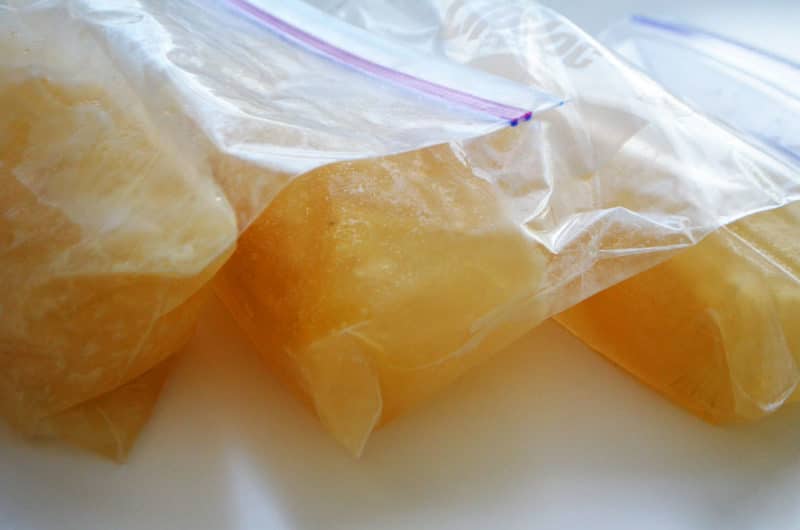
Warm gently on the stove over medium-low heat or lower heat until it just simmers, to add to recipes or make soup. Taste and adjust the amount of salt only after reheating.
Expert Tips
- Keep It at a Gentle Simmer
Avoid firm boiling on high heat. A low simmer or gentle simmer gives a clearer, more refined, cleaner-tasting stock. If you see vigorous bubbling, lower heat. - Skim During the First Half Hour
The foamy layer that rises early carries off-flavors and impurities. Removing it with a large metal spoon leads to a clearer, better-tasting basic chicken stock. - Use Cartilage-Rich Parts
Wing tips, chicken feet, necks, and chicken legs all contribute collagen. That’s what makes your homemade broth jell in the fridge and gives chicken soup a luxurious mouthfeel. - Don’t Salt Until You Use It
Because you might reduce the stock later or combine it with other salty ingredients, keep seasoning light. Adding salt when you use the broth in recipes gives you control over sodium content. - Roasting for Deeper Flavor
If you want an even richer flavor, roast your raw bones and vegetables before simmering. Using the browned roast chicken carcass is a great way to add complexity. - Save Everything!
Whenever you have leftover chicken bones, chicken carcasses, or veggie scraps, freeze them. When you’ve accumulated enough, you’re only a few hours from another batch of liquid gold. This is cooking with true economy.

Homemade Chicken Stock Recipe
Ingredients
- 4 pounds chicken, skin on, bone-in pieces. Roasted or raw.
- 1 large yellow onion, peeled and quartered
- 3 large carrots, trimmed and cut in 3-inch pieces
- 2 celery stalks, cut in 3-inch pieces
- 1 sprig parsley
- 1 sprig thyme
- 1 bay leaf
Instructions
- Remove excess fat from the chicken. If using a roasted chicken, remove any seasoned skin. Cut the chicken into pieces as needed to allow them to fit easily into the stock pot.
- Place the chicken, onion, carrots, celery, parsley, thyme, and bay leaf in a large pot with enough cold water to cover everything about 2 inches (ingredients will float at the surface at first).
- Heat just to the boiling point at medium-high heat. Immediately reduce the heat to medium low, a gentle simmer.
- With a large spoon, skim the surface to remove the residue solids (scum) that float to the top.
- Simmer uncovered for about 4 hours. Skim the top every so often, adding about ½ cup of cold water every hour as the stock evaporates.
- Strain the stock through a colander into a large bowl or container. Cool completely. Refrigerate in airtight containers for up to five days, or freeze in 1-2 cup portions in freezer bags.
Nutrition
Nutrition information is automatically calculated, so should only be used as an approximation.
Soup Recipes
Try any number of my favorite soups for that warm broth goodness, including Lebanese Vegetable Soup with Chickpeas and Kale, Avgolemono, and Lebanese Lentil Soup, Rushta.
















Stocks really are a beautiful thing:)))) Love this one Maureen:) LOVE THEM ALL! Keep em comin!!!! XO
Thank you Rini!
So it seems you’re not the only one talking stocks this week…
https://www.suntimes.com/lifestyles/10066424-423/at-the-chefs-table-it-all-starts-with-stock.html
No disrespect to this writer, but I enjoyed your piece so much more…
Sofia
Chicago Trib also had a ditty about stock, by the great Bill Daley. Stock on the brain all over the place…. Thanks for the good words and the link, Sofia!!
As much as I like french chicken stock, my favorite is middle eastern stock consisting of raw chicken, water, an onion, mastic pods, cardamon pods, Laurier leaves, pepper corn and some salt. The smell of the stock is divine. Lately I have learned to make the Chinese chicken stock which is also becoming a favorites. It is so simple. You just add to the water and chicken some raw ginger, some diced onions, some lime leaves and voila. So easy and so so good.
Have a great week-end.
Middle Eastern stock and Chinese stock…both sound aromatic and wonderful! Can’t wait to try them, thank you Karine!